
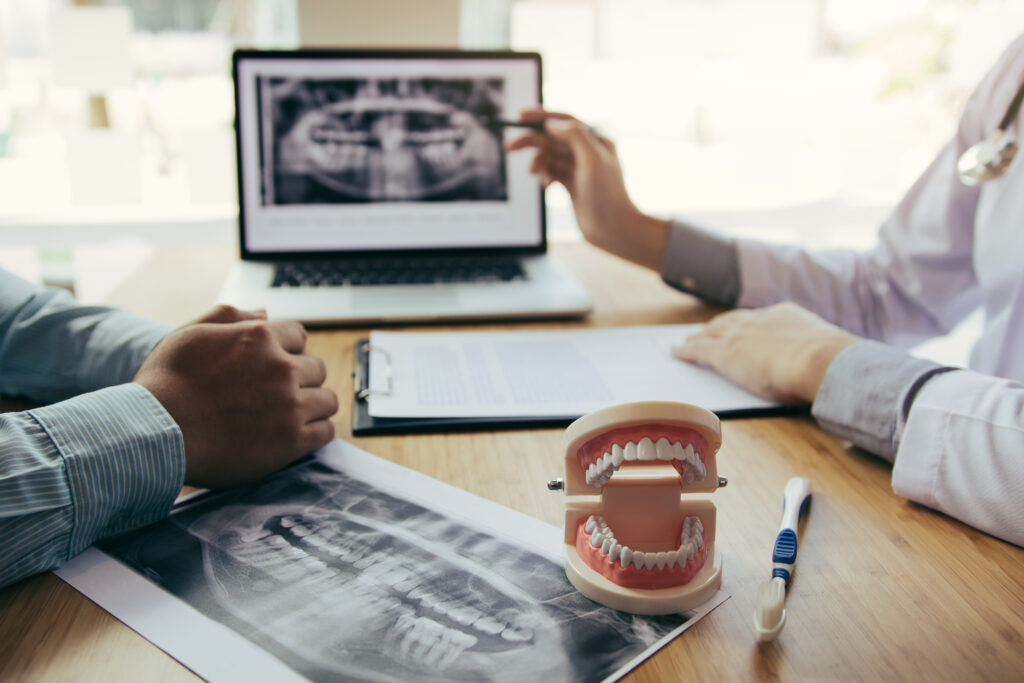
A traditional denture and an implant-retained denture solve the same problem in very different ways. If your denture has started slipping, needing more adhesive than it used to, or just feels less secure than it did when you first got it, an implant-retained denture is often the upgrade worth understanding.
At Wenatchee Dental Arts, Dr. John Divis, DDS, FAGD, has helped patients across the Wenatchee Valley weigh this exact decision for over 30 years. His evaluation begins with a 3D imaging scan of your jaw and a conversation about what your life actually needs from your teeth, not a menu of procedures. If you are wondering whether your denture could be more secure, learning about our approach to dental implants is a useful first step.
How Each Option Works
A traditional denture is a removable appliance, full or partial, that rests on the gum ridge and is held in place by suction, adhesive, or clasps on remaining teeth. It sits above the gumline rather than integrating with the bone below, which means its fit depends entirely on how well the ridge underneath continues to hold its shape.
What an Implant-Retained Denture Changes
An implant-retained denture anchors to two or more titanium posts placed in the jawbone rather than relying on suction alone. The posts fuse to the surrounding bone through a process called osseointegration, giving the denture a stable foundation that a traditional denture cannot replicate on its own. That stability is often what patients notice first: less slipping when eating or speaking, and less reliance on adhesive throughout the day.
According to the National Institute of Dental and Craniofacial Research, tooth loss among adults has declined significantly since the 1970s, though disparities remain in several population groups. The patients who seek Dr. Divis for implant consultations in Chelan, Douglas, Grant, and Okanogan Counties are increasingly asking about implant-retained options earlier, before bone loss has progressed far enough to complicate placement.
What Makes Someone a Candidate
Patients in the Wenatchee Valley come in for these consultations with widely different starting points. Bone volume, overall systemic health, and personal preference each shape what is actually possible. The conversation is not always “an implant-retained denture is better.” It is about what is realistic for this patient’s jaw and this patient’s life.
Evaluating Bone and Anatomy
Dr. Divis uses i-CAT® 3D Imaging for every implant case, not the single flat X-ray image that most general practices rely on for this decision. The scan maps bone density, nerve location, and sinus anatomy in a format that makes the difference between guessing and knowing where an implant can go.
Several factors shape whether an implant-retained denture is the right path. These are the most common:
- Bone density: Patients who have experienced significant resorption may need a bone graft before placement; the i-CAT® scan shows exactly how much volume is available.
- Systemic health: Uncontrolled diabetes, certain blood thinners, and prior radiation to the jaw each affect how bone heals around the posts.
- Smoking: Tobacco use is associated with higher implant failure rates and is a factor that Dr. Divis discusses directly with patients during evaluation.
- Gum health: Active periodontal disease needs to be treated before implant placement to reduce infection risk.
- Patient preference: Some patients genuinely prefer their current denture routine, and that is a valid choice when made with complete information.
Not every patient who asks about an implant-retained denture is a candidate on the first visit. Some get there after a bone graft; some decide their traditional denture still fits their situation better.
The Long-Term Difference
The practical difference between the two options shows up in years five through fifteen. Traditional dentures require relining or replacement as the jaw continues to change, because the same bone resorption that makes them fit loosely also keeps happening underneath them. Managing that fit is an ongoing task, not a solved problem.
An implant-retained denture, once the posts are integrated, holds its stability differently. Maintenance still matters: cleaning, hygiene visits, and protecting the appliance and posts from excessive force. Dr. Divis brought a strong clinical foundation from his 1991 University of Washington School of Dentistry education, and he has continued building on that training for over 30 years of continuing education. That commitment to ongoing learning has supported implant-retained restorations that continue functioning well for patients today.
Dr. Divis earned his fellowship designation from the Academy of General Dentistry, a credential held by fewer than six percent of general dentists in the United States. He also completed a 1999 in-hospital training program through the Society for the Advancement of Anesthesia in Dentistry for patients who need sedation dentistry to get through the surgical phase comfortably.
Schedule a Consultation at Wenatchee Dental Arts
Dr. John Divis, DDS, FAGD, graduated from the University of Washington School of Dentistry in 1991 and has spent over 30 years building a practice in Wenatchee focused on comprehensive, cosmetic, and comfortable dental care. He uses Instaräsa digital facial scanning for full-arch implant planning alongside i-CAT® 3D Imaging, a combination that most general practices in North Central Washington do not offer under one roof. Whether an implant-retained denture is the right upgrade for you or your current denture is still serving you well, that answer comes from a full evaluation, not a website.
If you are wondering whether your denture could be more secure and want a clear picture of what an implant-retained option involves, request an appointment at Wenatchee Dental Arts.